Showing posts with label voting right in bangladesh. Show all posts

Sunday, December 30, 2012

One Eleven shatters democracy in Bangladesh


Sheikh Hasina, the exiting Prime Minister of Bangladesh was
arrested during one eleven 2007 
11th January 2007 of Bangladesh is the much talked about One Eleven of the country. State of emergency was declared on this day of new year evolved from political chaos in the country on the point of parliamentary election in the country.

Khaleda Zia completed her office of Prime Minister for full term of five years. However, opposition Bangladesh Awami League could keep their confidence on the then proposed Chief of the Caretaker Government (CCG) and  they enforced bloody movement with clashes in the capital city and finally it won with emergency declaration on 11th January 2007.       

Sheikh Hasina, the current Prime Minister and the then opposition primarily extended her full support to the leaders of the Emergency Government mainly backed by the Lieutenant General Moeen U Ahmed, Chief of Army of Bangladesh.   


Khaleda Zia made a blunder by making Major General Moeen U Ahmed Chief of Army Staff by superseding 9 senior officers,which made all 9 her enemies and her choice Moeen, a batch mate of her brother Major Sayeed Eskandar (Retd.), betrayed her.

Major General Masud Uddin Chowdhury, brother in law of Sayeed Eskandar, was made GOC of 9 Division to check Moeen, also betrayed Khaleda Zia supporting Moeen unlikely, who was also betrayed by Moeen.

Masud was permanently superseded by Sheikh Hasina during Awami League period of 1996–2001 although he was a recruit of 'Raksmi Bahini', Awami League's first government Para-Military Force engaged in oppression and suppression to people. 

For betrayal Masud and Aminul Karim got reward with promotion to Lt. General posts where Fazlul Bari did not got anything other than transfer out of the country. Bari went to USA State Department in favor of Moeen for approval of Martial Law and make Moeen President. 

Later Masud and Bari were involved in a coup to topple Moeen and finally Moeen succeeded and oust both of them coming back from a trip outside. Sheikh Hasina rewarded Masud with extending his job of High Commissioner to Australia first with uniform and later without uniform at the pressure of some army officials due to his role in implementation of Moeen's assignment to arrest and torture on Tarique Rahman.

Moeen used to decide everything while in power whether there were balance of power, system of government, local government, role of military etc.

Khaleda Zia included Hussain Muhammad Ershad into 4 Party Alliances twice, once after 1996 when Awami League came to power and after BNP came to power in 2001. But, later Ershad left the alliance as BNP did not give him desired seats in the planned parliamentary election of 2007.

On 29th October 2006 Khaleda Zia's term in office ended. Before this day, the world saw a blood shed at the central point of Dhaka City which is just  500 meter far from the president residence. Open arms were shot at a Meeting of Bangladesh Jamaat Islami (BJI) by the then opposition Awami League (AL) activists on broad day light on 28th October 2006. Six Jamaat men were killed in that incident with lethal weapon by the AL. World saw huge dance on the dead bodies with weapons in hand. It happened due to uncertainty over who would succeed Mrs. Zia as chief advisor (Chief of Caretaker Government of Bangladesh).

On the same day evening, a presidential spokesman Mukhles Chowdhury declared that former Supreme Court Chief Justice Khondokar Mahmud Hasan (K M Hasan), who had been due to take over as Chief Advisor, would not be assuming the role due to ill health.

Subsequently, president Iajuddin Ahmed, assumed power as Chief Advisor on 29th October 2006. President tried his best and facing all odds. Presidential advisor Mukhlesur Rahman Chowdhury met both Khaleda Zia and Sheikh Hasina, solved political problems and met demands of Awami League and their allies.

As a result, on 24th December Sheikh Hasina announced that her grand alliance will participate in coming elections. At her demand Presidential Adviser negotiated with Election Commission and managed to extend two days to file nominations and officially on 26th December 2006 all political parties joined the elections of planned 22 January 2007.

The date of election was scheduled on 21st January, then 23rd January and finally it was rescheduled on 22nd January 2007 for come to consensus.

Then army chief Lt. General Moeen was involved in conspiracy to declare a state of emergency, which was made ready on 29th October 2006 following 'Logi-Boitha' massacre of previous day (28 October) and army was made stand by with one hour notice.

Khaleda Zia did not try to understand that Moeen will betray whereas Mukhles Chowdhury was divulging general's hidden agenda as he was only obstacle to that. Mrs Zia was annoyed why state of emergency was obstructed.

When H M Ershad's nomination was canceled, for the sake of holding elections what was done since late October 2006 until 3 January 2007 Mukhles Chowdhury had been urging all political fronts not to stop elections and not to do anything that hinders elections and opens way to take over by military.

Moeen group advised Zia to participate elections without Awami League and supported the formula of Hasina to go ahead with 'Logi-Boitha' and blockade programme to topple Iajuddin's Caretaker Government (CTG).

The group tried to create division within CTG and foiled army deployment in aid to civil power. There were three groups in army and one Aminul Karim had series of meetings with Moeen on military take over and he united the rival groups with the help of Fazlul Bari while Brig A T M Amin played major role in arresting and removing people from the government.

Amin informed US diplomat that Mukhlesur Rahman Chowdhury was removed and Rezzakul Haider Chowdhury was removed and arrested. He also gave life threat to Mukhles Chowdhury. Intelligence attempted to assassinate Mukhles Chowdhury.

Moeen and Aminul Karim had also secret meeting at Bangabhaban. Had Begum Zia understand the gravity of the situation she could allow Caretaker Government against so called State of Emergency and not to cancel Ershad's nomination. Military group betrayed with her. It is still mysterious that why she did not receive phone calls from Presidential Advisor on 11th January 2007 when Moeen was obstructed at the gate of Bangabhaban.

Even when thereafter MSP brought Moeen to his room then there had also been effort to connect with her from highest office at the part of political engagement as it was done with other top politicians and she was away.

All including DGFI, SSF, 9th Infantry Division of Bangladesh Army, 46 Brigade betrayed with democracy and constitution while President's Advisor was trying to the last for the sake of democracy and constitution.

DG, NSI and Commandant, PGR was also loyal. Army had connection with Awami league and Moeen was superseded 9 senior officers in appointing army chief what was a great blunder of BNP government.
Khaleda Zia now realises that making Iajuddin Ahmed as the Chief Advisor was wrong.


After tremendous domestic and international pressure and amid Awami League claims of partisanship, President Dr. Iajuddin Ahmed stepped down as Chief Advisor of the Caretaker Government of Bangladesh but remained as the President of Bangladesh. Elections scheduled for 22 January were postponed. The new caretaker government led by former Bangladesh Bank governor Dr. Fakhruddin Ahmed, in its fight against corruption, has targeted many of Mrs. Zia's BNP ministers.

Tareq Rahman, Senior Vice Chairman of BNP and eldest son
of  Khaleda tortured during Moeen regime   
Mrs. Zia's eldest son, Tareque Rahman, was also arrested in March 2007 for corruption. It was later reported that, beginning on 9th April, the government barred other politicians from visiting Mrs. Zia's residence due to the state of emergency, imposed in January, which prohibits political activity. Youngest son of Mrs. Zia, Arafat Rahman, was arrested on 16 April 2007.


Since United News Bangladesh (UNB) carried unverified reports of Arafat's arrest on 16th April 2007, it cited unnamed 'family sources' as claiming Mrs. Zia was considering exile. UNB said speculation was mounting Mrs. Zia would relocate to Saudi Arabia.


It also noted her brother, Major (Retd.) Sayeed Iskandar was attempting to negotiate her exit from Bangladesh with authorities from the interim administration. The New Nation newspaper carried a report on 17th April 2007 stating Khaleda had in fact agreed to go into exile in return for the release of her youngest son.

The report said the Saudi government had expressed its willingness to accept Khaleda and her family members as royal guests. Meanwhile, Bangladesh's The Daily Star quoted an unnamed source who claimed Zia's decision to leave the nation meant authorities would now force Awami League president Sheikh Hasina, Zia's bitter rival who was then in the United States, to also embrace exile. All these reports about exile and government pressure on Mrs. Zia were denied by the government.

On 19th April 2007, Khondker Babul Chowdhury, a member of the BNP national executive committee, filed the appeal urging the court to order the government not to send Khaleda abroad against her wish and challenging the reported confinement of Khaleda to her house. 

On 22nd April 2007 the High Court issued a rule on the government to explain within five days why the court will not direct the government to produce Khaleda Zia before the court to prove that she is not confined to her house. On 25th April 2007, in what was viewed as a reversal, the government said that Zia's movement was not restricted and that she had not been under any pressure to leave the country; it also dropped its ban on Hasina's return.

On 7 May, the government was ordered by the High Court to explain restrictions on Mrs. Zia that were said to remain in place.

On 17 July 2007, the Anti Corruption Commission Bangladesh (ACC) sent notices to both Mrs. Zia and Mrs. Hasina, requesting that details of their assets be submitted to the commission within one week.
Mrs. Zia was asked to appear in court on 27th September 2007 in connection with a case for not submitting service returns for Daily Dinkal Publications Limited for years.

On 2nd September 2007, a case was filed against Mrs. Zia by the interim government for corruption regarding the awarding of contracts to Global Agro Trade Company in 2003, and on 3rd September 2007 she was arrested. Her youngest son Arafat Rahman (Coco) along with 11 others was also detained after police recorded a corruption case against them involving irregularities at Chittagong port. 

A bribery case was also filed against current Prime Minister of Bangladesh Sheikh Hasina (rival of Khaleda), detained in a special jail. 

On the same day, Mrs. Zia expelled party Secretary General Abdul Mannan Bhuiyan and Joint Secretary General Whip Ashraf Hossain for breaching party discipline. On 30th September 2007, Mrs. Zia was granted bail by the High Court, which also ruled that the trial should be stopped on the grounds that the emergency laws could not be applied to her actions before they were imposed in January 2007. The government appealed this decision, however, and on 4th October 2007 the Supreme Court ruled that she should not be granted bail and that the trial should continue.

After Khaleda Zia was detained, party standing committee members chose former Finance Minister Saifur Rahman and former Water Resources minister Major (Rtd.) Hafizuddin Ahmed to lead the BNP for the time being; Mrs. Zia's supporters did not recognize this.

Bangladesh Election Commission subsequently invited Hafizuddin's faction, rather than Mrs. Zia's, to participate in talks, effectively recognizing the former as the legitimate BNP. Zia challenged this in court, but her appeal was rejected on 10th April 2008.

Mrs. Zia's youngest son Arafat Rahman (Coco) was released in August 2008, and her eldest son Tareque Rahman was released on bail on 3rd September 2008. Mrs. Zia had been granted bail on two of her four cases by this point, but remained in jail because bail had not been granted for the other two. Her lawyers said on 4th September 2008 that they would also seek bail for the other two cases.

However, finally an election was held on 29th December 2008 and Sheikh Hasina came to power with more than two-third majority. HM Ershad, one of the major component in the ruling 14-party grand alliance even made a comment in the Parliament that "none but the Army only took them into power".

However, due to imbalanced result of the 1/11 government election both the government and opposition were below the balanced line which leads the country to danger.        

Saturday, December 29, 2012

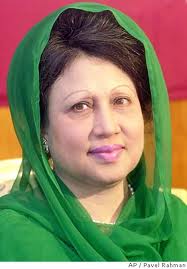
Khaleda Zia portraits democracy in Bangladesh

Begum Khaleda Zia, Chairperson of BNP, leader of the Opposition, former
Prime Minister of Bangladesh, unveiling some books on democracy
and human rights in Dhaka earlier in 2012.
Begum Khaleda Zia is the Chairperson of Bangladesh Nationalist Party (BNP), one of the largest political party of Bangladesh. Begum Zia is mostly known for her moderate view of democracy, human rights, development, trade, education and tolerance of all views, religions, casts and communities.  

She was the first woman in the country's history and second in the Muslim world (after Benazir Bhutto of Pakistan in 1988–1990) to head a democratic government as prime minister. She is the widow of President Ziaur Rahman, who was assassinated in 1981. President Ziaur Rahman was the most populous Leader of the Nation for his philosophy of multi-party democracy system instead of single party dictatorship.   

She was born on 15th August 1945. She is the first Bangladeshi politician who was Prime Minister of Bangladesh for two full times which was from 1991 to 1996 and again from 2001 to 2006.

After a bloodless coup in 1982, led by Army General Hussain Muhammad Ershad, Khaleda Zia led the BNP. She has been elected as Prime Minister three times, and she has been elected to five separate parliamentary constituencies in the general elections of 1991, 1996 and 2001. She did not even fail in any parliamentary election from any where of the country till now. 

Forbes magazine ranked Mrs. Zia at number 29 in 2005 and number 33 in 2006 in its list of the 100 Most Powerful Women in the World.

A neutral caretaker government oversaw elections on 27 February 1991 that were broadly considered to be free, fair and truly democratic. The BNP won 140 seats, 11 short of a majority. However, it was the only party capable of forming a government, and Khaleda Zia was sworn in as the country's first female prime minister on 20th March with the support of a majority of the deputies. Acting president Shahabuddin Ahmed granted her nearly all of the powers that were vested in the president at the time, effectively returning Bangladesh to a parliamentary system. With a unanimous vote cutting across all political lines, the BNP-led government formally restored the parliamentary system through the 12th amendment to the Constitution in 1991.

The BNP had a landslide victory on 15th February 1996 general election to the sixth Jatiya Sangshad. The election was, however, boycotted by all other major parties, Awami League, Jamaat Islami and Jatiya Party, who were demanding that the elections to be held under a neutral caretaker government, following allegations of rigging in a by-election held in 1994. Turnout was estimated at around 25%, though the government at the time claimed it to be much higher. 

The short-lived parliament hastily introduced the Caretaker Government through 13th amendment to the Constitution, and then was dissolved to pave the way for the parliamentary elections. In the 12 June 1996 polls, BNP lost to Sheikh Hasina's Awami League but emerged as the largest opposition party in the country's parliamentary history with 116 seats.

Aiming to return to power, the BNP formed a four-party alliance on 6 January 1999 with its former political foe the Jatiya Party, and the Islamic party of Bangladesh Jamaat-e-Islami and the Islami Oikya Jote and launched several agitation programmes against the ruling Awami League.

Khaleda Zia was criticized much for making alliance with Jamaat-e-Islami, the party which opposed the independence of Bangladesh in 1971 on political views and stand. 

The four-party alliance then participated in the 1st  October 2001 general elections and won the election with a two-third majority of seats in parliament and 46% of the vote and Khaleda Zia was once again sworn in as the Prime Minister of Bangladesh.

Under the rule of Awami League Government, on 13th November 2010 she was forced to leave her 37th years old, palatial Dhaka Cantonment residence upon an order from High Court Division of Bangladesh Supreme Court. 

The house was originally the residence of the Deputy Chief of Staff (DCS) of Bangladesh Army used by then DCS Major General Ziaur Rahman. He kept the same residence even after he had become the President of Bangladesh. The post of DCS of Bangladesh Army was abolished in his tenure. After the assassination of Ziaur Rahman this house was leased-for-life to his widow Khaleda Zia at only ৳101 by then Acting President Justice Abdus Sattar on 12th June 1981, by then Former Army Chief of Bangladesh and Chief Martial Law Administrator Lieutenant General Hussain Mohammad Ershad in 15th June 1982. After Leaving the house, she moved to the house at Gulshan of her brother Sayeed Iskandar.

Begum Khaleda Zia made a number of high profile foreign visits in the later part of 2012. She visited Saudi Arabia in August 2012 after being invited by the Saudi royal family and performed umrah. She called on the Saudi crown prince and defence minister Salman bin Abdulaziz Al Saud to talk about bilateral ties and access of Bangladeshi migrant workers to the Saudi labour market, which to a number of extents was in a decline at the time.

At the People's Republic of China
She went to People’s Republic of China in October, at invitation of Communist Party of China, and called on Chinese leaders including Vice President Xi Jinping and CPC’s international affairs chief Wang Jiarui. The meeting with Jinping was noted to be significant as the latter is set to begin taking over as China’s Paramount Leader by the end of 2012.

Talks in China mostly comprised trade and prospective Chinese investment in Bangladesh, particularly the issue of financing Padma Bridge which was stalled at the beginning of 2012 after World Bank, a major prospective financier, withdrew accusing government ministers of rampant graft. After Khaleda Zia came back, her party BNP, the main opposition, announced that the Chinese funding for a second Padma Bridge was confirmed amid her visit.

At India
On 28th October 2012, Khaleda Zia visited India and was about call on President Pranab Mukherjee, Prime Minister Manmohan Singh and a number of officials including foreign minister Salman Khurshid, national security adviser Shivshankar Menon, foreign secretary Ranjan Mathai and BJP leader and leader of opposition Sushma Swaraj. Talks were scheduled to cover issues like bilateral trade and regional security.


Khaleda’s India visit became subject to widespread attention as her party BNP has been generally assumed to maintain a somewhat anti-India stance in face of its rival Awami League’s much assumed acclaim as pro-India. Khaleda Zia amid her meeting with Prime Minister Manmohan Singh clarified that her party does not find any harm done to India to come to its interest either politically or nationally. Giving hint that any future BNP-led government would continue the ongoing Indo-Bangladesh effort to fight extremism, Khaleda said, “Religious extremism continues to be a living concern in the region and there is necessity of joint efforts to fight it.”

Despite the fact that there has been a general assumption among the ruling quarters of India that the anti-India forces gain in the greater region when BNP comes in charge of Bangladesh, Indian officials following Khaleda’s meet with the Prime Minister released statements that they have come to agreement with Khaleda to pursue a common geopolitical doctrine in the greater region. Khaleda was yet to call on the national security advisor and foreign minister when the statement came out.

On 24 May 2011, New Jersey State Senate Honored Begum Khaleda Zia as Fighter of Democracy. Both treasury bench and opposition members of New Jersey State Senate unanimously adopted a resolution honoring Begum Zia and all the senators gave her a standing ovation. New Jersey State Senate accorded such honor to any foreign personality for the first time.


Mrs. Zia has now been fighting for restoration of Caretaker Government System (CGS) with 18-parties alliances. It is to be noted here that ruling AL cancelled the electoral system CGS in 2010. AL observed 173 days hartal (strike) during 1994 to 1996 for realisation of the CGS but they cancelled the system from constitution after being in power in the beginning 2009. 

However, Begum Zia has now been fighting for the peoples right for democracy for long while her husband presented multiparty democracy in Bangladesh.